



Lot n° 188
Estimation :
300 - 400
CHF
Result without fees
Result
: 250CHF
Bukhara Tekké carpet (wool warp, weft and pile), West Turkes - Lot 188
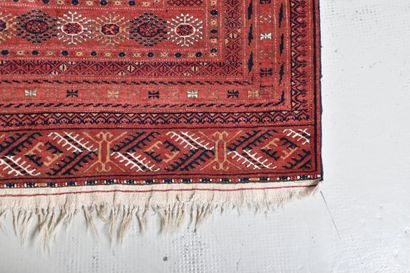
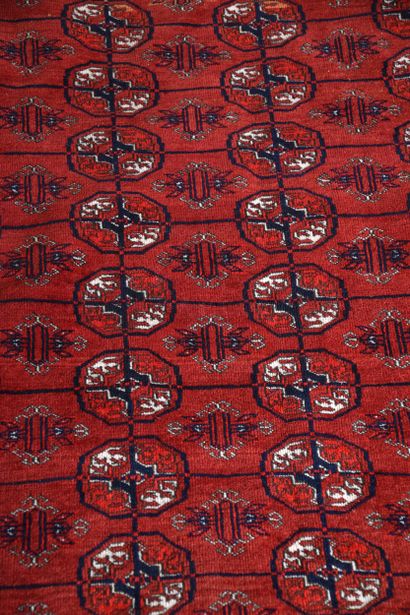
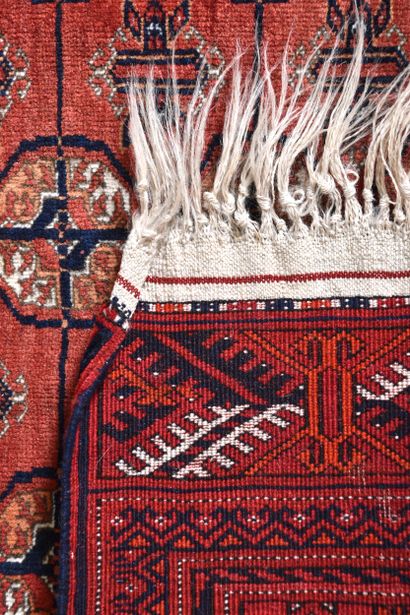
Bukhara Tekké carpet (wool warp, weft and pile), West Turkestan, circa 1940-1970. The carpet is decorated with seven rows of twenty gulhs on a red background.
A border with a succession of small geometric floral medallions is framed by numerous borders.
330 x 220 cm
The Turkmen people, originally from the remote steppes of Asia, were made up of different tribes
the main ones being the Salor, Tekké, Yemouth and Saryk.
Nomadic and semi-nomadic, they lived in round yurt tents, and carpet-making was essential to their daily lives.
was essential to their daily lives and festivals, and an integral part of their tribal tradition.
tribal tradition. In fact, most carpets have a specific, distinct function, which we'll look at later.
and were part of the bride's obligatory dowry.
Women were responsible for their manufacture, since dyeing and spinning wool, as well as flat-knotting
and knotting on a flat loom were easily adapted to daily life and the burden of
children, of whom there were many. The men had to tend and shear the sheep, and sell the
and sell surplus carpets at market.
The more women in a family, the more carpets were produced, mainly after the spring shearing.
after spring shearing.
The red fields of the carpets, which range from deep wine-red to red,
are adorned with designs that vary from tribe to tribe. These designs may seem simple, but they
rich symbolism, taking us into an ancestral tribal world,
full of charm and warmth.
"Each Turkmen tribe has its own gulh. It's round or octagonal in shape, and divided into four
divided into four by thin black lines that form a rectangular grid on the field.
rectangular mesh. The center of the gulh is adorned with a star motif and each of its parts is alternately red and black.
alternately red and black. Thin diagonal rods called eagles' feet extend from its edge.
edge. Within the rectangular mesh of the grid, secondary gulhs appear, alternating
alternate with the main ones. The most frequent of these is a St. Andrew's cross motif, known as a chemche gulh or gulh.
chemche gulh or spoon gulh".
Bibliographical reference:
SABAHI, T - Splendeurs des tapis d'Orient - Ed Atlas, Paris - 1987 - p 316 à 318
Lot appraised on photo with the usual reservations
by Cabinet Alexandre CHEVALIER Paris
My orders
Sale information
Sales conditions
Return to catalogue